

Have you seen the chatter about Google’s preferred sources over the last week or two, and wondered if it’s something your business needs to act on? You’re not imagining the noise. Google made an announcement on 20 August 2026 that set the SEO world off again, and the guides have been landing thick and fast ever since. Here at Sharpstones I’ve been separating what Google actually said from what marketers are doing with it, and telling you plainly whether to sit up and take notice, or let it pass you by.
What’s new?
Preferred Sources isn’t brand new. Google first launched it back on 12th August 2025 in the US and India. It enabled visitors to a website to mark their favourite news outlets so they’d see more from them in Top Stories. (Source: ppc.land) It was then rolled out globally in every language Google Search supports on 30 April 2026. (Source: Google)
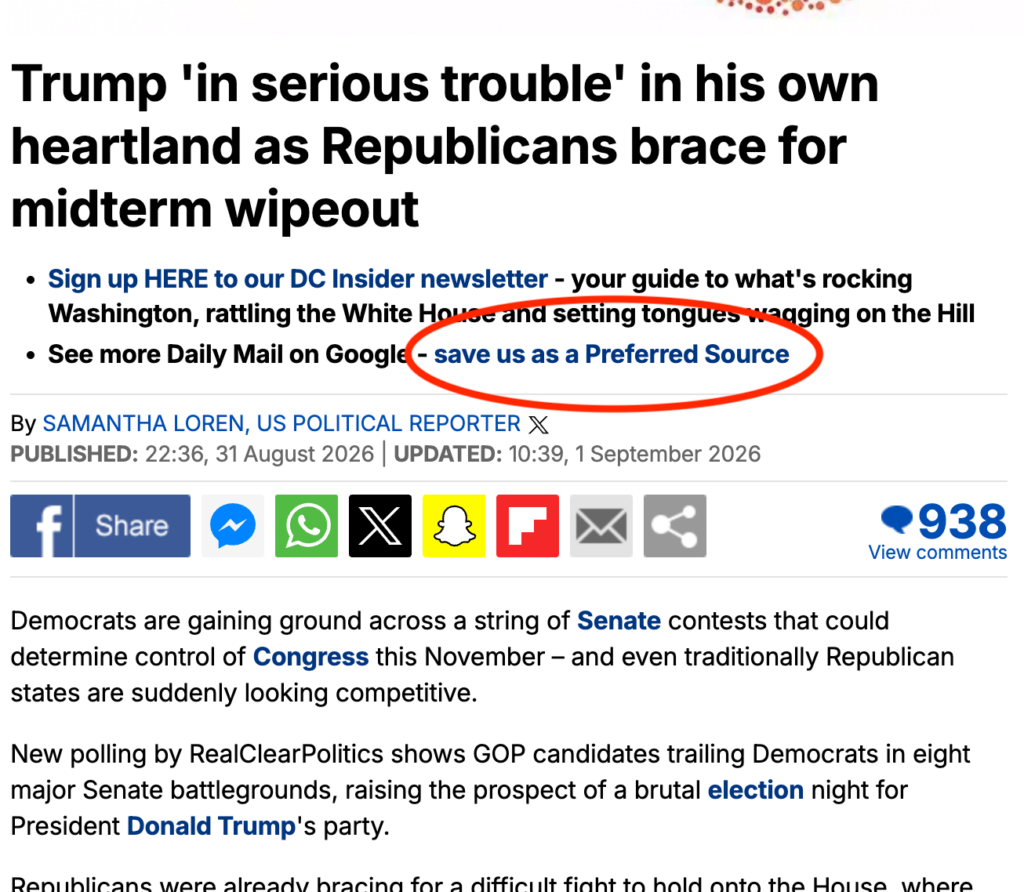
The bit that’s got everyone talking now is the recent 20th August update. Until then, readers could only mark a site as preferred from Google’s own source preferences page but Google has now given publishers a two line piece of code to embed an interactive button directly on their own site. Readers can then click “preferred” without leaving the page, and these picks now show up Top Stories, AI Overviews and AI Mode too, each carrying a small “preferred” label. Google says “people have already selected more than 600,000 unique sources” this way, and that they “are twice as likely to click through to a preferred source when available.” (Source: Google; TechCrunch) Four days later, Google went further with a one click version built into articles themselves, which the Telegraph, the Guardian and the Daily Mail have already added, each doing it slightly differently. (Source: Press Gazette)
Who is this for?
Preferred Sources lives inside Top Stories, Google Discover, Google News and AI Overviews. Those are platforms built around news and regularly published editorial content. Google’s developer guide confirms the button is only available at domain or subdomain level, and it says that the button itself is optional: “It’s not required to do them in order to appear as a preferred source.” (Source: Google Search Central) In other words, being chosen depends on whether Google already treats you as a news style source, not on whether you’ve pasted a bit of code onto your homepage.
The businesses actually benefiting so far are newspapers, magazines and content heavy sites that already show up in Top Stories and Discover. It’s also why Press Gazette’s coverage leans on a study from the Association of Online Publishers showing organic Google Search referrals to publishers fell 7.1% between Q1 and Q2 2025, with a 50% drop projected by Q3 2027. (Source: Press Gazette) This feature is Google’s answer to publishers losing traffic to AI generated answers, not a general purpose ranking boost for any old website.
Should you sit up, or let it pass by?
For the vast majority of small and medium local businesses, this is one to let pass you by. If your site isn’t the kind of thing that turns up in Top Stories, Discover or AI Overviews for news style queries, adding the button won’t make you eligible. It won’t hurt you either, Google hasn’t said it affects normal search rankings, but it also won’t do the job some of this week’s more excitable posts are promising!
There’s one situation worth sitting up and taking a note of: if you run a proper content operation alongside your core business. A UK travel operator publishing regular destination guides, a legal practice putting out timely commentary on law changes, or a trade publication in your niche could realistically build an audience this way, provided Google already recognises the site as a source in those platforms.
A homepage badge, or one on every post?
Google doesn’t say. Its own documentation states you can place the button “anywhere you’d like” and stops there, with no guidance on a single best spot and no claim that placement affects anything. (Source: Google Search Central) The examples I’ve found in the wild back that up. Some publishers use a homepage badge, others (like the papers above) put it inline on individual articles. That’s a design choice, not a Google requirement, so treat any blog post telling you there’s one correct placement as opinion dressed up as rule.
Our verdict
Sit up and take notice if you’re a UK news site, magazine or content driven publisher. It’s a free, low effort addition and worth having a developer add the two lines of code. Let it pass you by if you’re a local service business reading this because your feed told you to panic. Your energy this month is better spent on your Google Business Profile, your reviews and making sure your actual site converts, not on a badge built for a problem newspapers have and most local businesses don’t.
I’ll keep an eye on whether Google expands eligibility beyond news style content, and if that changes, I’ll write about it. Until then, treat with a pinch of salt anyone who tries to sell you a “preferred source” badge as an SEO must have for a local trades or services website.