
(Updated on 13 October 2026)
Update, October 2026: The change went live on 17 August. Two months on, I’ve looked at what Google has said, what advertisers are seeing, and what to do if your cost per lead has crept up: Has Your Google Ads Cost Per Lead Crept Up Since August?
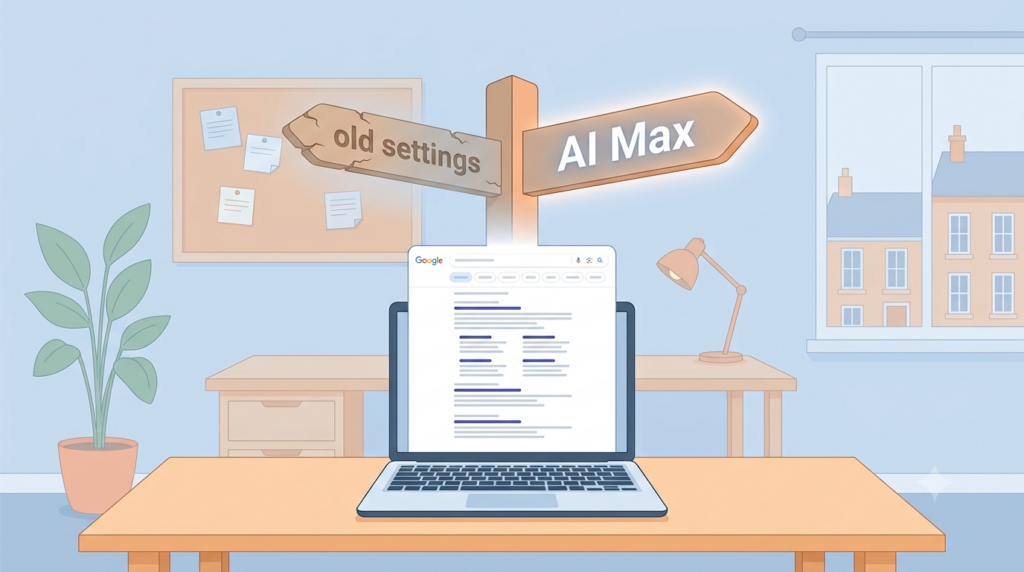
If you run Target CPA or Target ROAS on a campaign that’s limited by budget, this one affects you. On 17th August 2026, Google updated its bidding systems so that these campaigns now perform closer to the number you actually typed in, rather than the better, more efficient number the algorithm had been quietly finding for you behind the scenes.
Yes, you read that right. Google changed Smart Bidding so that certain over-performing campaigns became less efficient on purpose.
What changed
Imagine this scenario: You set a Target CPA of £10. Your daily budget is tight, so the campaign gets marked as “Limited by budget”. Until 17th August, Smart Bidding handled budget limits by cherry-picking only the absolute cheapest, highest-converting auctions. Over a few months, your actual CPA settled at £5, half your target. You probably never complained, because converting at half price is a great outcome.
Since 17th August, that quiet win has gone away. According to Google Ads Help documentation on target-based bid strategies, a budget-constrained campaign with a £10 target that currently delivers a £5 CPA now delivers much closer to the £10 target you originally set.
The update impacts Target CPA, Target ROAS, and Target CPC (for Demand Gen campaigns). Google’s FAQ guidance says the change applies to Search, Shopping, Performance Max, Demand Gen, and Travel campaigns. It does not affect Manual CPC, Target Impression Share, App, or Video campaigns, nor does it impact campaigns with healthy, unconstrained budgets.
Google’s stated reasoning is that budget changes used to cause unpredictable efficiency swings, and locking delivery to your explicit target provides more consistent results when scaling. That makes engineering sense, but whether it is a welcome discovery on a campaign you haven’t reviewed in eighteen months is a different story.
Who is in scope?
Before the change, Google flagged accounts using a 12-month lookback: if a campaign had been limited by budget at any point in the previous year, you’d have seen a notification. Google also launched a Bid Target Adjustment Tool inside Google Ads on 6 July 2026, which lists affected campaigns alongside their historical performance.
If you manage your own account and haven’t checked yet, it’s worth doing now. Look for any campaign marked “Limited by budget” that uses Target CPA or Target ROAS.
What to actually do about it
- Find your affected campaigns. Look for campaigns marked “Limited by budget” using Target CPA or Target ROAS. If Google’s Bid Target Adjustment Tool is still showing in your account, it will list them for you.
- Compare set targets against actual performance. If your Target CPA is set to £20 but your actual recent CPA is £11, that campaign will have seen costs drift upwards since 17 August, unless someone has changed the target.
- Decide deliberately. You have four main options:
- Match your actual performance: Update your target down to match recent performance (£11) to lock in your current efficiency.
- Increase your daily budget: Remove the budget constraint entirely so the campaign can scale cleanly at your current target.
- Switch your bid strategy: Change to Maximize Conversions or Maximize Conversion Value. These strategies focus on getting the highest volume within your set budget without an explicit CPA or ROAS ceiling.
- Leave it as is: Accept that performance will drift closer to your original target in exchange for potential volume gains.
- Leave unaffected campaigns alone. This update is not a reason to re-tune or disrupt campaigns that are not budget-limited.
The bigger takeaway
I’d expect brand campaigns and mature accounts with legacy bidding targets to have been hit the hardest by this change. Brand search naturally converts cheaply, making it a prime candidate for quietly beating targets under budget caps without anyone noticing.
More than anything, this update is a reminder that “set and forget” automated bidding strategies still require regular human oversight. The account wasn’t set up wrong. The platform simply changed the underlying rules.
Not sure whether any of your campaigns were affected? Take my free 60-second PPC audit or drop me a line at will@sharpstonesmedia.co.uk.