
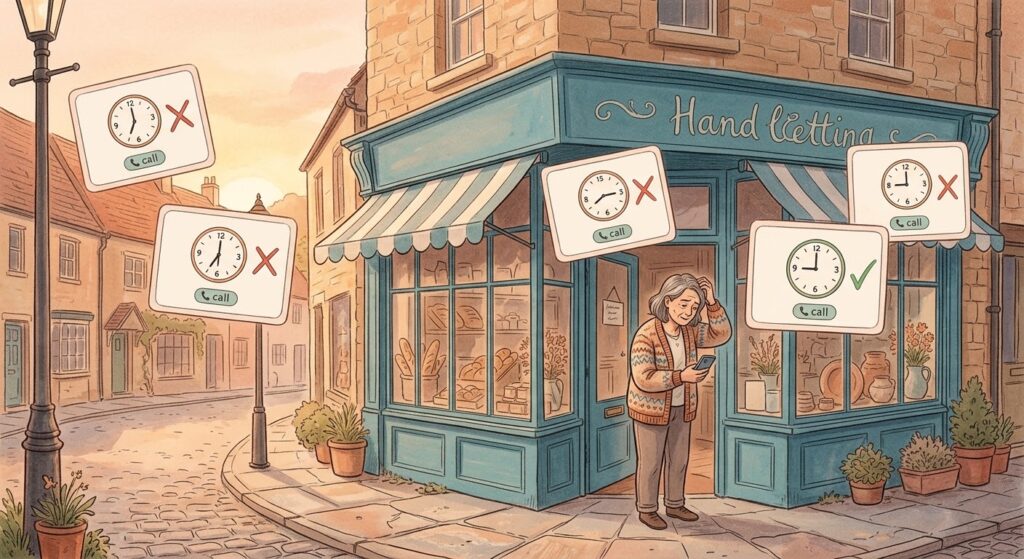
In 2021, Better Retailing checked the opening hours of 300 of the UK’s best convenience stores, all picked because they’d been recognised in industry awards. 63% had the wrong hours on at least one platform, and more than half had the wrong hours on Facebook.
These are well run shops, so I doubt the rest of us are doing much better. It usually happens in a fairly ordinary way. You change your hours on Google and forget about Facebook. You get a new phone number and Yell still has the old one. Someone set up a listing for you years ago and nobody has the login any more. Nobody notices until a customer turns up to a locked door.
While putting together a free guide on this, I found a few things worth sharing.
Google can change your profile
I’d always assumed a Google Business Profile shows whatever the owner puts in it. That’s not quite how it works.
Google’s help page says it updates profiles using information from “different sources, like user reports and licensed content”, as well as your website. Some edits suggested by the public can go live without you seeing them first. With others you get an email and four days to accept or reject. If you don’t respond, Google says it “may automatically publish the update if it is supported by other publicly available information, such as your business website.”
So if your website, your directory listings and your Google profile all say different things, Google ends up deciding which version is correct. If your old phone number appears on more sites than your new one, Google could well go with the old one.
One platform feeds another
Bing Places lets you import your details from your Google profile. Microsoft says its new import is “better at preserving key attributes like business name, hours, and contact details.” That’s useful when your Google details are right, but it copies any mistakes across as well.
Apple Maps, which also feeds Siri, used to take its business information from “partners like Foursquare, Yelp and Tripadvisor”, according to TechCrunch. Apple Business Connect now lets you manage your own listing, but if you haven’t claimed it, Apple is still relying on what other sites say about you.
AI tools use your listings too
More people are asking ChatGPT or Google’s AI Mode to recommend a local business, and the answers come from what’s already published about you.
Last month BrightLocal published a study of 1.9 million citations from 200,085 local searches on ChatGPT, Google AI Mode and AI Overviews. Google Business Profile was the biggest single source, at 28.6% of citations. Yelp, Facebook and Tripadvisor were also on the list, and business websites made up 42% overall.
Whitespark surveys local search specialists every year about what affects rankings. Its 2026 report, based on 47 experts, says “In AI SEO, mentions (citations) are the new link.” The same report puts your website’s name, address and phone number matching your Google profile 15th out of 187 factors for ranking in the map results.
Nobody outside these companies knows exactly how the AI tools weigh things up. My view is that if one finds three different phone numbers for you, it’s less likely to recommend you.
What customers do about it
In 2017, Nominet, which runs the .uk domain registry, found 61% of independent businesses had wrong or missing opening hours online. 63% of shoppers said they’d never go back to a business they’d found closed when the internet said it was open. That research is old, but the convenience store figures above suggest things haven’t improved much.
BrightLocal’s 2023 survey of 1,138 US consumers found 62% would avoid a business after finding wrong information about it online. 46% said a wrong address made them lose trust, and 45% said the same about a wrong phone number.
Most of the time you won’t know it’s happened. The customer just rings someone else.
How to sort it out
Start by writing your details down in one place: business name, address, main phone number, website and opening hours. Write the address exactly the same way each time, down to whether it’s “Road” or “Rd”. That’s your master copy.
Then work through your listings and make each one match. I’d start with Google Business Profile, Bing Places, Apple Maps and Facebook, as so much else pulls from them. After that, Yell, FreeIndex, Nextdoor, Hotfrog and Cylex. Check your own website’s footer and contact page too, because Google uses your website to check everything else.
I’ve written a free nine page guide that takes you through all nine platforms, step by step, in plain English. You can download it from the free listings guide page.
Why I care about this as a PPC consultant
If you run Google Ads with location assets, your ads show the address from your Business Profile. If that’s wrong, you’re paying for clicks from people who’ve just been given the wrong details.
Once your profile is right, you can also see how it’s performing, because Google Business Profile now reports straight into Google Analytics.
Once it’s done, it only needs checking when something changes, like your hours or your phone number. If you’d like me to look over your listings with you, get in touch.