
I was down a bit of a rabbit hole on Google’s own developer blog last week, yes, that really is how I spend some evenings, when I found a quietly significant one. If you run Google Ads, or someone runs them for you, something is changing to your account this month whether anyone asks permission or not.
The AI Max change
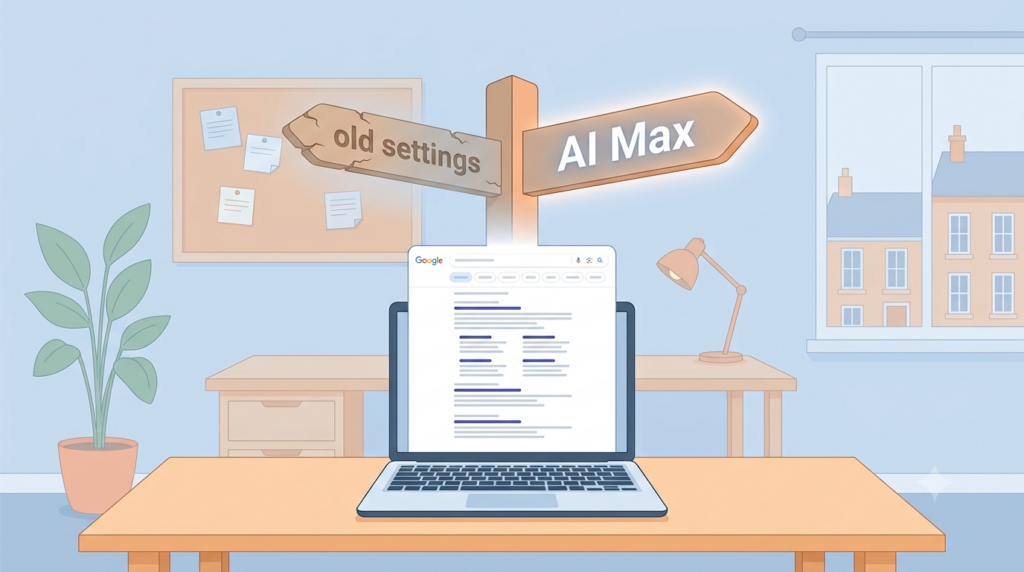
Google Ads has a couple of older settings that some Search campaigns still use. One is called campaign level broad match, which widens the searches your ads can show for beyond your exact keywords. The other is automatically created assets, which is Google writing extra bits of ad text for you based on your website. Both are now being folded into AI Max, Google’s newer AI driven system that decides matching, ad text and landing pages all at once.
Google has already blocked anyone from setting these older options up fresh since 3 August 2026. Then, between 1 and 30 September 2026, which is right now as I write this, every campaign still using them gets automatically upgraded to AI Max. Google says campaigns “will be migrated in place to equivalent AI Max settings” to keep disruption to a minimum. (Source: Google Ads Developer Blog)
There’s a second wave coming too. Dynamic Search Ads, where Google builds ads straight from your website content, get the same automatic treatment between 1 and 28 February 2027.
This affects you
If you manage your own Google Ads account, this affects you directly. If someone else does it for you, an agency, a freelancer, a nephew who’s “good with computers”, it still affects you, because your account is changing shape without anyone necessarily flagging it.
What jumped out at me was the settings your account lands on after the switch aren’t identical depending on what you were using before. Campaigns that had broad match switched on come out the other side with a setting called Text Customisation turned off. Campaigns that had automatically created assets switched on come out with Text Customisation turned on. (Source: Google Ads Developer Blog) That’s not a small technical footnote, it’s Google deciding how your ad copy behaves for you, based on a setting you might have switched on years ago and forgotten about.
The good news is your brand safety settings, the inclusions and exclusions stopping your ads showing for the wrong terms, carry over automatically.
Check your account
If you or your agency use campaign level broad match or automatically created assets, have a look at your account this week rather than next month. Check what your Text Customisation setting has landed on and whether that’s actually what you’d choose. Keep an eye on your search terms report a bit more closely than usual for the next few weeks, since AI Max style matching tends to widen where your ads appear, and widening without watching is how budgets quietly drift.
I wrote about Bing Ads doing something very similar with its own AI Max system a few weeks ago, and the pattern is the same one repeating itself. Both platforms are pushing hard towards AI making more decisions for you. That’s not automatically bad, but it does mean the businesses paying closest attention to their accounts right now are the ones who’ll come out ahead, and the ones who ignore it are the ones who’ll be asking in three months why their cost per lead crept up and nobody can say exactly why.
If you’d rather someone else kept an eye on this for you while you get on with running your business, then give me a shout.